I'm always happy to help share information. The more we share, the more we learn. And I don't care if you live in Alaska or Cape Hope or anywhere inbetween. Our world works best when we work together.
Another site that could help in learning about solar ovens and how to make them can be found at www.solarcookingatlas.com. It shows how to make a solar cooker as well as some videos and links to recipes.
Check it out!
Sunday, July 24, 2011

Success! Progress and moving forward
Ok. It's been a little while since I progressed on my solar cooker- the fryer. I'm updating with what is current.
The aluminium foil just would not work for me. I decided to scrap it, pull it off and clean the dish. This took some doing as glue isn't known for letting go. But I got a lot off.
My 2nd attempt was with a high gloss silver spray paint. While the application was easy, I could never generate much heat from it.
I kept looking around town for 'reflective tape', but everyone kept pointing me to the tap used on mailboxes and so on. This wasn't what I was looking for. I considered finding some broken mirrors and gluing the pieces to the dish. While this sounded cool, I decided not to do it this time. My first goal is to have a fully functional solar fryer and I knew I had a long way to go.
One day as I sat thinking about the mirror and the reflector tape, I mumbled that I wanted the tape to act as a mirror. Mirror tape. So I put that into google and hit enter. Lo and behold, I found it. I found it here at identi-tape.
One of my goals was to use local and easy to get items, but I wasn't getting far doing that. I really like the idea of using broken mirror pieces to create a sort of mosaic to achieve this down the line, but for this go around, I chose this mirror tape.
So I received it. I proceeded to put it on the dish.

As you can see, the foil and paint still show, but they are nothing compared to the tape. I continued to put it on.

As I went I learned that if I were to do it again, I would start with the center and move out. This would save some overlapping of the tape.

I had purchased a 3 way clamp with the silver spray paint and had painted it black (using ... black spray paint). I was never sure if it would hold the heat, but I liked the idea of it holding the pot or pan on top.
I put it out into the sun to 'fire it up' and try to boil some water.

I put a thermometer in the water to measure the heat.


I stood back and watched the heat rise.

It slowly rose to about 155 degrees. But it wouldn't budge much higher. Why? Well ...


The wind was blowing and it helped blow high clouds over head. Before long there was too little sun to produce heat. I was frustrated as I felt I was on the verge of success. I abandoned the project until the sun came out.
A few hours later it was blazing. No clouds. I went out and started it up again.

It quickly rose up to 160 and held at 165. Now if you look carefully at the picture above, you'll see the bright light under the pan hitting the piece of wood I use. As I tilted the dish down a little, the wood began to smoke -a lot-. I tilted it back and decided to try cooking with this.
I chose a single egg as my first attempted meal made with the solar cooker. I used the water to water a small chili plant I hope is going to grow and then dropped in some butter and the egg after the butter melted.


I had quiet hopes that it would cook quickly. I broke the yoke and stirred it a bit.

After several minutes, it began to cook! It was slow and a bit frustrating. And exciting. I had a mesh of feelings inside of me stirring at once. Slowly, over the course of 10 minutes,


And it did. I finally removed it from the pot, placed the solar oven in the shade and took it inside. I shared my single egg and enjoyed it completely.
I need to seriously modify this before I can call it good. I need a more solid base (the wood isn't level as it is boughed). I need to figure out a way to have the pan placed up above the dish, and be able to adjust its length as well as adjust the level for the pan (or pot). I do believe the clamp is not helping at all. I may opt for a method to suspend the cooking dish so it gets the direct sunlight.
So I've a ways to go. But you can see I am getting there. I am excited and hopeful that this will become exactly what I envisioned- an almost daily option to cook my meals without any other power than the sun.

The aluminium foil just would not work for me. I decided to scrap it, pull it off and clean the dish. This took some doing as glue isn't known for letting go. But I got a lot off.
My 2nd attempt was with a high gloss silver spray paint. While the application was easy, I could never generate much heat from it.
I kept looking around town for 'reflective tape', but everyone kept pointing me to the tap used on mailboxes and so on. This wasn't what I was looking for. I considered finding some broken mirrors and gluing the pieces to the dish. While this sounded cool, I decided not to do it this time. My first goal is to have a fully functional solar fryer and I knew I had a long way to go.
One day as I sat thinking about the mirror and the reflector tape, I mumbled that I wanted the tape to act as a mirror. Mirror tape. So I put that into google and hit enter. Lo and behold, I found it. I found it here at identi-tape.
One of my goals was to use local and easy to get items, but I wasn't getting far doing that. I really like the idea of using broken mirror pieces to create a sort of mosaic to achieve this down the line, but for this go around, I chose this mirror tape.
So I received it. I proceeded to put it on the dish.

As you can see, the foil and paint still show, but they are nothing compared to the tape. I continued to put it on.

As I went I learned that if I were to do it again, I would start with the center and move out. This would save some overlapping of the tape.

I had purchased a 3 way clamp with the silver spray paint and had painted it black (using ... black spray paint). I was never sure if it would hold the heat, but I liked the idea of it holding the pot or pan on top.
I put it out into the sun to 'fire it up' and try to boil some water.

I put a thermometer in the water to measure the heat.


I stood back and watched the heat rise.

It slowly rose to about 155 degrees. But it wouldn't budge much higher. Why? Well ...


The wind was blowing and it helped blow high clouds over head. Before long there was too little sun to produce heat. I was frustrated as I felt I was on the verge of success. I abandoned the project until the sun came out.
A few hours later it was blazing. No clouds. I went out and started it up again.

It quickly rose up to 160 and held at 165. Now if you look carefully at the picture above, you'll see the bright light under the pan hitting the piece of wood I use. As I tilted the dish down a little, the wood began to smoke -a lot-. I tilted it back and decided to try cooking with this.
I chose a single egg as my first attempted meal made with the solar cooker. I used the water to water a small chili plant I hope is going to grow and then dropped in some butter and the egg after the butter melted.


I had quiet hopes that it would cook quickly. I broke the yoke and stirred it a bit.

After several minutes, it began to cook! It was slow and a bit frustrating. And exciting. I had a mesh of feelings inside of me stirring at once. Slowly, over the course of 10 minutes,

it began to cook

And it did. I finally removed it from the pot, placed the solar oven in the shade and took it inside. I shared my single egg and enjoyed it completely.
I need to seriously modify this before I can call it good. I need a more solid base (the wood isn't level as it is boughed). I need to figure out a way to have the pan placed up above the dish, and be able to adjust its length as well as adjust the level for the pan (or pot). I do believe the clamp is not helping at all. I may opt for a method to suspend the cooking dish so it gets the direct sunlight.
So I've a ways to go. But you can see I am getting there. I am excited and hopeful that this will become exactly what I envisioned- an almost daily option to cook my meals without any other power than the sun.

Monday, May 30, 2011
Heritage
I stood on a hill overlooking Phoenix International Raceway to the west, the Gila River to the east and the Salt River to the north. The hill overlooked the confluence of 2 major rivers that have been apart of the history of the region of the Sonoran Desert, in what is today Phoenix, for 1000s of years.
Before the Americans, the Mexicans. Before the Mexicans, the Spanish. Before the Spanish were those who have gone before us. And yet they remain amongst us. Native Endians have been around for 1000s of years. They built an advanced civilization here, in Phoenix, that lasted for 1200+ years. I wonder if Phoenix will last that long. We certainly have the capability, if we are smart and not greedy. Right now, Phoenix is 130+ years old.
There were 2 gentlemen with their children and dogs. The children were keen to go do something. The men reluctantly were led away. They had enjoyed being up there, I think. The sun wasn't quite summer hot, though it beamed down on all on a cloudless day. Behind me was a gentleman and his son. After the others departed, we talked a bit. His son had turned 13 that day. And his father was showing him his heritage. He was telling him about hiking in the moonlight up in the estrellas. He was talking to him about the rivers. He told me he was sharing his heritage with his son- just as his father had done, and his grandfather before him and so on. His family had been in the area a long long time.
I told him I wish I had had that in my life. I told him I had to learn about the rich culture and history here, on my own. He seemed pleased to hear this and hoped his son was paying attention. We chatted about the rivers and the dams and the power plant he worked at. We chatted about petroglyphs and where to go and see some. He soon departed with his son. I turned my gaze back to the rivers and the mountains and the desert I live in.
I haven't had a heritage. I have no history with a land, a place my parents shared with me. I have no Illinois or Wisconsin or Mississippi or New York or even Arizona. My heritage and history was a constant movement between towns and suburbs. Mostly suburbs. I am a product of a poor part of suburbia. I never had a tie to land in any meaningful way. I chose Arizona as my home as an adult- though I had been here since I was a youth. I chose to live in the desert and dwell as one from the desert. I have no stories from this place that my parents can share that aren't town-centric. I can't point to a place where we vacationed when it was too hot to stay in the valley. I can't relate the rich history of a city or region. I didn't have the heritage, the oral tradition, the traditions, the people or practices.
I had some tidbits from external to my family, from a time in scouting and volunteering and exploring in my youth. And those are the roots of what little I have. I live in the desert and that means I must learn the desert, learn its strengths, weaknesses, how to coexist and thrive in a way that doesn't require me to subjugate it as we see so many in suburbs do (and this is so very hard for people to understand or do- including me). Should I live in Florida, I would learn to live that way. Should I live in New York City, I would try and do the same (god help me).
I hope I can create stories to tell my children so they can relate to theirs. Ones of the land, the water, the sun above and the deserts and mountains below. And I hope others do the same. And if you have that rich tradition- enjoy it and share it.
 |
| PIR |
Before the Americans, the Mexicans. Before the Mexicans, the Spanish. Before the Spanish were those who have gone before us. And yet they remain amongst us. Native Endians have been around for 1000s of years. They built an advanced civilization here, in Phoenix, that lasted for 1200+ years. I wonder if Phoenix will last that long. We certainly have the capability, if we are smart and not greedy. Right now, Phoenix is 130+ years old.
 |
| Gila (what's left of it) |
There were 2 gentlemen with their children and dogs. The children were keen to go do something. The men reluctantly were led away. They had enjoyed being up there, I think. The sun wasn't quite summer hot, though it beamed down on all on a cloudless day. Behind me was a gentleman and his son. After the others departed, we talked a bit. His son had turned 13 that day. And his father was showing him his heritage. He was telling him about hiking in the moonlight up in the estrellas. He was talking to him about the rivers. He told me he was sharing his heritage with his son- just as his father had done, and his grandfather before him and so on. His family had been in the area a long long time.
 |
| Salt |
I told him I wish I had had that in my life. I told him I had to learn about the rich culture and history here, on my own. He seemed pleased to hear this and hoped his son was paying attention. We chatted about the rivers and the dams and the power plant he worked at. We chatted about petroglyphs and where to go and see some. He soon departed with his son. I turned my gaze back to the rivers and the mountains and the desert I live in.
I haven't had a heritage. I have no history with a land, a place my parents shared with me. I have no Illinois or Wisconsin or Mississippi or New York or even Arizona. My heritage and history was a constant movement between towns and suburbs. Mostly suburbs. I am a product of a poor part of suburbia. I never had a tie to land in any meaningful way. I chose Arizona as my home as an adult- though I had been here since I was a youth. I chose to live in the desert and dwell as one from the desert. I have no stories from this place that my parents can share that aren't town-centric. I can't point to a place where we vacationed when it was too hot to stay in the valley. I can't relate the rich history of a city or region. I didn't have the heritage, the oral tradition, the traditions, the people or practices.
I had some tidbits from external to my family, from a time in scouting and volunteering and exploring in my youth. And those are the roots of what little I have. I live in the desert and that means I must learn the desert, learn its strengths, weaknesses, how to coexist and thrive in a way that doesn't require me to subjugate it as we see so many in suburbs do (and this is so very hard for people to understand or do- including me). Should I live in Florida, I would learn to live that way. Should I live in New York City, I would try and do the same (god help me).
I hope I can create stories to tell my children so they can relate to theirs. Ones of the land, the water, the sun above and the deserts and mountains below. And I hope others do the same. And if you have that rich tradition- enjoy it and share it.
Sunday, May 1, 2011
Solar fryer
Parabolic solar cookers. I had long thought of something like them. I saw a neat idea at http://www.greenpowerscience.com/, where they used a fresnel lens to focus the heat off a mirror onto their cookware to make eggs, spaghetti and .. popcorn, I think. I think the popcorn failed, but you get the idea. Or not. Here's a link to that site (and yes, it is popcorn) http://www.greenpowerscience.com/SOLARCOOKING.html
I love their videos.
Anyways. I was at the state fair last year when I saw a project a student was doing to generate electricity. He was using an old dish that was discarded to focus the sun onto a heat sink (I think) with a power generator on top of it. He had pictures of it and so on. I thought 'why not do the same, but cook with it? So I looked about for a dish. I have some amazing friends who own a home with an old dish on top. So I asked them if I could come and take it off of their hands. "Sure" they replied. And I did.
I took it home and looked at it for a while. I decided to build a stand for it. So I went to Home Depot and found some scrap wood for a few dollars and grabbed some screws for a few dollars. Total cost: 8 bucks. I then made an "H" stand for it, and mounted it. From there, I glued aluminum foil on the dish itself. (Eventually I will replace with reflective tape- should I ever find some).
At this point, I simply want to test. It will be rudimentary. Eventually I want to be able to adjust it for the sun, and have a swivel plate to put a frying pan on (or whatever).
I came up with this:

Notice the 'H' stand, the aluminum foil that isn't very smooth and how very 'thrown together' the whole thing is. It will mature as I go along.

I used a coat hanger to create the stand. After playing around I found the 'sweet spot' and placed it so the sun would reflect at that exact point. I took my trusty solar pot (it is black and a leftover from an old camping set). Initially I just put a thermometer on the coat hanger stand. It reached 225. I got excited. I replaced the thermometer with the pot- with water in it. I put the cover on.
The pot got hot. The water got hot. Bubbles formed and steam came off of it. I was hopeful this would mean it would go to a full boil. But, alas, it did not. I am not sure how much of this was due to the wind we've been getting. I know it is playing a factor, but not sure how much.
But it did something. So then I considered what to do about making a plate for it. I cast about for what I had on hand. We have a few skewers that I never use a veggie grill plate for a propane stove. And I came up with what is below.


It never boiled. The temperature got to 150, but that's not high enough. But you can see the sun is being concentrated on the pot. The goal, ultimately, is to focus it on the plate and get it hot enough to use a frying pan on top of it. I'll update as I go on this.
I love their videos.
Anyways. I was at the state fair last year when I saw a project a student was doing to generate electricity. He was using an old dish that was discarded to focus the sun onto a heat sink (I think) with a power generator on top of it. He had pictures of it and so on. I thought 'why not do the same, but cook with it? So I looked about for a dish. I have some amazing friends who own a home with an old dish on top. So I asked them if I could come and take it off of their hands. "Sure" they replied. And I did.
I took it home and looked at it for a while. I decided to build a stand for it. So I went to Home Depot and found some scrap wood for a few dollars and grabbed some screws for a few dollars. Total cost: 8 bucks. I then made an "H" stand for it, and mounted it. From there, I glued aluminum foil on the dish itself. (Eventually I will replace with reflective tape- should I ever find some).
At this point, I simply want to test. It will be rudimentary. Eventually I want to be able to adjust it for the sun, and have a swivel plate to put a frying pan on (or whatever).
I came up with this:

Notice the 'H' stand, the aluminum foil that isn't very smooth and how very 'thrown together' the whole thing is. It will mature as I go along.

I used a coat hanger to create the stand. After playing around I found the 'sweet spot' and placed it so the sun would reflect at that exact point. I took my trusty solar pot (it is black and a leftover from an old camping set). Initially I just put a thermometer on the coat hanger stand. It reached 225. I got excited. I replaced the thermometer with the pot- with water in it. I put the cover on.
The pot got hot. The water got hot. Bubbles formed and steam came off of it. I was hopeful this would mean it would go to a full boil. But, alas, it did not. I am not sure how much of this was due to the wind we've been getting. I know it is playing a factor, but not sure how much.
But it did something. So then I considered what to do about making a plate for it. I cast about for what I had on hand. We have a few skewers that I never use a veggie grill plate for a propane stove. And I came up with what is below.


It never boiled. The temperature got to 150, but that's not high enough. But you can see the sun is being concentrated on the pot. The goal, ultimately, is to focus it on the plate and get it hot enough to use a frying pan on top of it. I'll update as I go on this.
Solar ovens in general
Ah solar. I love it. If it didn't cost 2 arms, a leg and a 20 year leash, I'd have solar panels on my roof right now. A solar hot water heater would be on that list (and yes, I am aware that they are not as cost effective as an energy efficient hot water heater, but my goals are to run as much from the sun as I can).
A passive solar house is something I dream of, think of, and want. As I have to convince others who share my home with me on this, it isn't going to happen overnight. But I'll get there. :-)
There are several types of solar cookers:
The ones I've shown in previous posts are 'box cookers'. Meaning they take in the sun and retain the heat, and this, in turn, cooks the food.
Panel cookers reflect the sun from several panels to concentrate the light and heat in a direction to cook the food. The CooKit is one such example. And the only reason I did not get one of these is because they require a plastic bag to be used, and my goals were to make something that didn't require me to have to buy more of something. I do believe they also offer a template of these, should you want to make your own, but the money they make is donated - and they aren't expensive.

This is an image of the CooKit (http://solarcooking.wikia.com/wiki/CooKit) Panel cooker.
Solar Kettles- I don't know anything of these. I've not seen them.
Parabolic cookers - I've been intrigued by these. The box cookers are great, but you can't stir fry veggies (and I love stir frying veggies), you can't make scrambled eggs, you can't grill up food in them. They aren't made for it. Parabolic cookers can. So if you have both, you eliminate the need for your oven and stove combo. And why would I want that? Here in Phoenix, the summer daytime temps go above 110 and the nighttime temps can hang around in the 90s. Thus, it is hot hot hot. Normally the desert cools off at night, but the city is so large that we have a 'heat island' effect, and so the concrete retains the heat and cooks our brains.
Any person on a budget views summertime electric bills here with fear. It is damn hot and it is damn expensive to cool your house (unless you have a passive solar home, in which you may still require some cooling options because of the heat island). Cooking anything in your house simply heats it up. That's great when it is cold outside, but sucks beyond belief when you are trying to lower the temperature inside of it. And running the oven and stove forces the AC (or Swamp Cooler) to run harder and longer.
Some people grill outside all summer. Some people cook and bake in the early hours of the day. Me? I'd like to use the sun to do my cooking for me. So .. parabolic cookers. Interesting idea.

The one posted above tries to do, in my opinion, what a box cooker does.
According to the wikia page, there are also hybrid solar cookers that can either use the sun or electricity. I call this cheating. But I readily admit that nothing sucks worse than having clouds roll in and your meal is left unfinished. And that is a downside to solar cooking.
A passive solar house is something I dream of, think of, and want. As I have to convince others who share my home with me on this, it isn't going to happen overnight. But I'll get there. :-)
There are several types of solar cookers:
The ones I've shown in previous posts are 'box cookers'. Meaning they take in the sun and retain the heat, and this, in turn, cooks the food.
Panel cookers reflect the sun from several panels to concentrate the light and heat in a direction to cook the food. The CooKit is one such example. And the only reason I did not get one of these is because they require a plastic bag to be used, and my goals were to make something that didn't require me to have to buy more of something. I do believe they also offer a template of these, should you want to make your own, but the money they make is donated - and they aren't expensive.
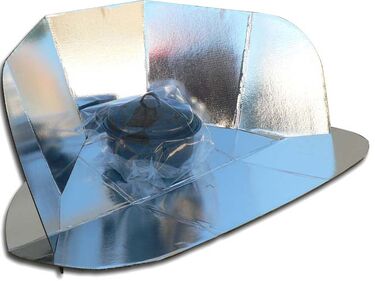
This is an image of the CooKit (http://solarcooking.wikia.com/wiki/CooKit) Panel cooker.
Solar Kettles- I don't know anything of these. I've not seen them.
Parabolic cookers - I've been intrigued by these. The box cookers are great, but you can't stir fry veggies (and I love stir frying veggies), you can't make scrambled eggs, you can't grill up food in them. They aren't made for it. Parabolic cookers can. So if you have both, you eliminate the need for your oven and stove combo. And why would I want that? Here in Phoenix, the summer daytime temps go above 110 and the nighttime temps can hang around in the 90s. Thus, it is hot hot hot. Normally the desert cools off at night, but the city is so large that we have a 'heat island' effect, and so the concrete retains the heat and cooks our brains.
Any person on a budget views summertime electric bills here with fear. It is damn hot and it is damn expensive to cool your house (unless you have a passive solar home, in which you may still require some cooling options because of the heat island). Cooking anything in your house simply heats it up. That's great when it is cold outside, but sucks beyond belief when you are trying to lower the temperature inside of it. And running the oven and stove forces the AC (or Swamp Cooler) to run harder and longer.
Some people grill outside all summer. Some people cook and bake in the early hours of the day. Me? I'd like to use the sun to do my cooking for me. So .. parabolic cookers. Interesting idea.

The one posted above tries to do, in my opinion, what a box cooker does.
According to the wikia page, there are also hybrid solar cookers that can either use the sun or electricity. I call this cheating. But I readily admit that nothing sucks worse than having clouds roll in and your meal is left unfinished. And that is a downside to solar cooking.
Solar oven part 3 - my baby
I spent a lot of time thinking about how I could cook in the winter time, with the sun so low in the sky. I considered wooden solar ovens. I considered buying a solar oven online, but my goals had always been to do this with as little expense as possible. And up to this point, I had succeeded. I read online (http://en.wikipedia.org/wiki/Solar_cooker) and spent a lot of time thinking about it. My birthday was approaching and I was asked what I wanted. I sent off a link of a solar oven I had eyed, but didn't put much stock into getting as it cost a good chunk of change.

To my surprised, I did get it.

This solar oven came from The Solar Oven Society. Included in the kit was the oven itself, 2 pots with lids, the reflector (not shown) the thermometer and a device to tell you when water is potable (should you need to treat your water). It also worked year around, simply by turning it over and lying it on its back. This allowed it to get more direct sunlight from the lower angles of winter-time sun.
(As as aside, these ovens are made from recycled plastic as they state here: "The plastic portions of the Sport are produced from post-consumer PET or recycled pop bottles using a special process developed exclusively for the Solar Oven Society. It takes 68 20-ounce recycled pop bottles to make one oven. The Sport is one of the first products, and the largest injection molded part, made from post-consumer PET.")
As long as the weather wasn't cloudy and the temperature wasn't below 40 degrees, I could cook. And I did. I have used this oven between 1 and 3 times a week since then. I've baked bread in it, cooked steak, made chili, stew, 'baked' potato, and many other things. I am slowly working on gathering recipes that I can and will share as I go.
Now, please don't be discouraged. I plan on using all 3 ovens to try and show what you can cook with them. And I still plan on trying to put together an oven that is inexpensive and usable year around. My goals are still to cook using as frugal a method as possible- while still making good food.
Solar oven part 2
After a winter of cooking inside, I looked forward to cooking outside. I also wanted a bigger and better solar oven. I spent time researching online on other kinds of solar ovens. They ranged from commercial grade solar ovens to a an inflated car tire tube with a sheet of glass placed on top (I believe that was done in Kenya- how cool is that?) I also saw one that was built into the house, itself. I still want to do one of those, one day!


So I had ideas on how to improve my solar oven. Well, by improve I mean replace. I targeted a copypaper box as my next project. In the meantime, I was trying to cook in the sun in April and having some success. As ever, it is trial and error. Finally, I was able to secure a box (ie, the girlfriend brought one home from work as it was being tossed out). I spent time and put it together, according to the instructions given.

It came out beautifully. Immediately, I could get the temperature up to almost 200. I could cook more and it retained heat better than the pizza box. I, however, wanted to bake with it. And while I could and *did* make a small loaf of bread in it successfully, it took 8 hours in the blazing July sun in Arizona to do this. I really did not like that outcome at all. Something seemed amiss to me. So I decided to insulate it, to bump up the temperature.
Below are images of the oven with the top off. The rock is there to, um, look pretty. Actually, I took these pictures on a windy day and I didn't want them to fly away.
I took some cardboard and covered them in aluminum foil and put them in, angled to try and focus more light onto the pot that would be inside. I then used newspaper as insulation to retain that heat. This enabled me to up the temperature to 225-230. I could (and did) now bake bread and cook meat.

(Notice the newspaper I used as insulation)


But, the sun grew lower in the sky as it always does and by the fall equinox, I could only generate up to 195 degrees. Within a few weeks, I couldn't cook much of anything. I put a brick under the backside of the oven to boost it up and I gained a little more time and use with it.
But while these are great for late spring, summer and early fall, they don't cook well in the winter. I had to, as I had the year prior, put it away.
Subscribe to:
Posts (Atom)